Best Practice Statements
The resources below are free to download. Please revisit this section regularly, as more best practice resources will become available.

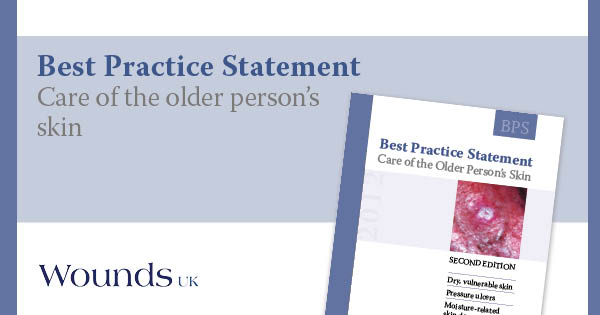
Care of the older person’s skin: Best practice statement (Second edition) VIEW PDFThe aim of this best practice statement is to provide relevant and useful information to guide those active in the clinical area, who are responsible for the management of skin care in an ageing patient population.
Best Practice Statement: The use of topical antiseptic/antimicrobial agents in wound management, 2nd editionVIEW PDFThis document has been compiled to fulfill a distinct need. The literature on the management of wound infection has been criticised for its paucity of reliable evidence. This, we believe, is because there are Cochrane-style systematic reviews drawing attention...
Effective management of wound infection and quality of lifeVIEW PDFInfection is a significant problem for people with wounds, as it can delay healing, result in unpleasant symptoms such as exudate and pain, increase length of treatment, and result in hospital admissions with prolonged stays, raising the costs of care. It...
Your chance to peer review two best practice statementsVisit the Wounds UK peer review website to read and comment on two new best practice statements
Best Practice Statement: The use of topical antiseptic/antimicrobial agents in wound managementVIEW PDFThis Best Practice Statement has been produced in accordance with the standards set out by the Appraisal of Guidelines for Research and Evaluation (AGREE) collaboration (AGREE, 2003). A working group was formed as a result of concern arising from a paper...
Consensus Document: PHMB and its potential contribution to wound managementVIEW PDFIf the use of PHMB is to ascend into the armoury of the UK wound care clinician, there needs to be careful review of its effectiveness, control of its use in clinical practice, and education of clinicians at the forefront of wound care. It is the intention...
Best Practice Statement: Care for the Older Person's Skin (First Edition)VIEW PDFThose charged with caring for the sick and vulnerable in the UK are faced with the challenge of ensuring that their practice is of the highest standards, while often working with heavy workloads which can be a barrier to reviewing research literature on...
Best Practice Statement: Compression HosieryVIEW PDFThis Best Practice Statement explores issues related to the selection, application and evaluation of compression hosiery to guide health care professionals towards the most appropriate use of compression hosiery products when used to prevent venous leg...
Best Practice Statement: Development of a FormularyVIEW PDFBy using this document it is hoped that a relevant wounds dressing formulary can be created which includes a range of clinically- and cost-effective products to meet the patient’s wound care requirements, regardless of care setting.
Best Practice Statement: Gauze-based negative pressure wound therapyVIEW PDFThis Best Practice Statement has been developed in an attempt to take the first steps towards reaching a consensus on the use of gauze-based negative pressure wound therapy (NPWT). This technique, also known as the Chariker-Jeter method, was first published...
Quick Search Buttons
CompressionDACCDebridementExudateHoneyHydrofiberMoisture LesionsPHMBPressure Ulcers