
Wound care is a field with a rapidly evolving evidence base to support new innovations; however, the quality of the evidence may be variable. Can you think of a time when you’ve read several studies, all of which suggest different treatment pathways for the same wound type? If so, which do we trust?
This is where we need to use our evidence appraisal skills to evaluate the studies to determine the best course of action, as clinical decisions are only as good as the evidence they’re based on. This editorial is aimed at clinicians working in wound care who regularly encounter new research, products and proposed interventions, and who want practical ways to judge the quality and relevance of the evidence underpinning them.
Evidence-based practice
Evidence-based practice (EBP) is more than ‘using evidence’. The central facets of EBP include best available evidence, clinical expertise, and patient values and preferences (Critical Appraisal Skills Programme [CASP], 2026a). In this respect, ‘best available’ refers to the quality of the evidence; if the evidence is of poor quality, this results in poor clinical decisions. Importantly, a positive or statistically significant result does not automatically indicate high quality evidence. Common limitations of wound care research often relate to small sample sizes, heterogeneity of wounds, lack of randomisation and blinding, and varying outcome measures. Yet these aspects may not be obvious unless we adopt a critical lens when evaluating wound care evidence, whether that be reading a journal article or speaking with colleagues from industry about their products.
This is why critiquing tools and reporting guidelines are essential – not optional. That said, a detailed appraisal of evidence in clinical practice can be time‑consuming. So, how can we strike a balance that ensures we take a questioning approach to the evidence we encounter? In this editorial, I outline a selection of critiquing frameworks and tools that can support systematic evaluation of evidence, while remaining feasible for everyday practice. I will also offer a short set of guiding questions that can be used as a framework for critical appraisal.
One of the key resources to help with appraising evidence is CASP (2026b). The checklists are free to use and are accompanied with ‘how to use’ guidance. The Joanna Briggs Institute (2026) also offers a comprehensive suite of critical appraisal tools, which can be used instead of, or alongside, CASP resources. Firstly, you will need to choose the appropriate checklist for the type of study. The study authors should provide a clear account of their study in the ‘Methods’ section of a paper; if they don’t, you need to be able to identify the key features of the study to select the correct checklist.
Where should clinicians begin with evidence appraisal?
A practical starting point is to adopt one appraisal tool and use it consistently before experimenting with others. Consider discussing critically appraised papers within team meetings: if each team member appraises a different paper, a shared library of evaluated evidence can gradually be built. When working with healthcare students, invite them to justify clinical decisions with reference to published evidence, reinforcing the link between theory and practice.
This approach can also help normalise critical discussion of evidence and reduce reliance on anecdote or habit. It may also make the technique of questioning evidence seem more normalised and less threatening if it is regularly practised. Once you feel confident with one the of the tools, explore the other checklists to choose a structure that best suits your learning style and clinical context. Whichever tool is used, these checklists help identify both the strengths and limitations of a study, and its applicability to clinical practice. Essentially, they provide a structure that can make appraisal feel more accessible and less overwhelming.
In addition to critiquing checklists, which are used by the reader, reporting guidelines are (or should be) used by authors and journals to help to ensure studies are reported in a transparent and reproducible way. Common reporting guidelines include:
- CONSORT: for randomised controlled trials
- STROBE: for observational studies
- PRISMA: for systematic reviews
- CARE: for case studies
- ACCORD: for consensus methods in biomedicine.
The Equator Network is a valuable resource for all reporting guidelines (Equator Network, 2026). Reporting guidelines do not guarantee the quality of the study, but they should make it easier to identify potential methodological issues affecting the quality of a study (i.e. if there are gaps in the reporting of the methodology or results of a study, this should lead you to question the quality). For clinicians reading research, reporting guidelines can be used as a reference point for what should be reported – where information is missing or unclear, this should prompt critical questioning of the study’s rigour and reliability.
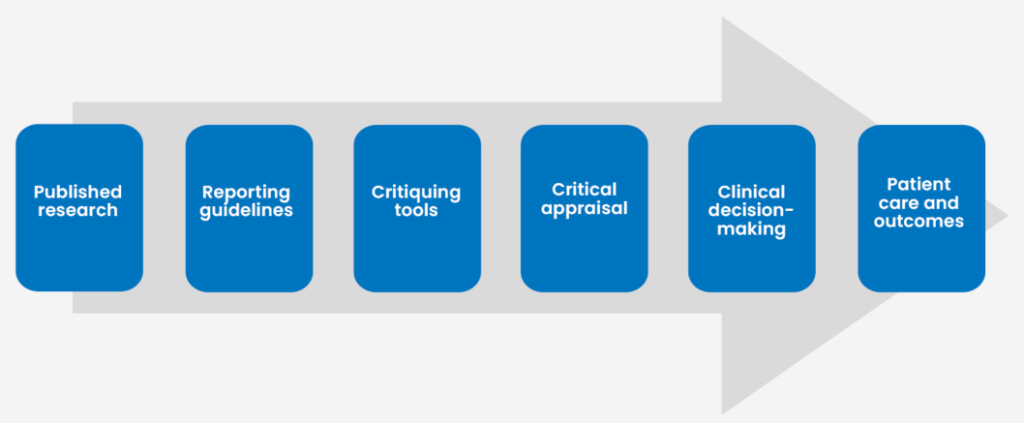
Figure 1 brings the process of appraisal together to show how published research supports clinical decision-making, patient care and ultimately EBP.
Collectively, the use of critiquing tools alongside scrutiny of how well a study is reported supports a more rigorous approach to appraisal. Why? Because evidence is used to develop clinical guidelines, clinical pathways and wound care formularies, as well as education and training programmes. Ultimately, these can impact (both positively and negatively) on patient safety and outcomes, so we need to evaluate the evidence on which we base our clinical practice.
CLEAR in practice
There’s often limited time to undertake a detailed appraisal of a study based on a checklist/tool, so I would ask you to remember the mnemonic CLEAR:
- C – Clinical question: What problem is the study trying to solve?
- L – Logic of methods: Does the way the authors do the study make sense?
- E – Explained well: Is the study clearly reported and understandable?
- A – Are the results believable? Do the findings seem trustworthy and useful?
- R – Relevant to practice: Could this apply to your patients or setting?
I am not suggesting that CLEAR should always replace full critical appraisal, but it might help to provide a pragmatic entry point for busy clinicians, as well as supporting a more informed, reflective engagement approach to evidence.
Critically appraising evidence is not about becoming a researcher or an academic expert; it is about becoming a more confident, questioning clinician. Whether you are reviewing a published paper, evaluating a new product, or discussing a treatment option with a patient, taking a structured, critical approach to evidence helps ensure that decisions are defensible, transparent and grounded in best practice. Even small, consistent steps towards appraisal can have a meaningful impact on the quality of care we deliver.