In this editorial, I make no apology for two things: repeating myself, and building on the work of others — call it borrowing, pinching with pride, or whatever you like. The reality is, the evidence is there. We just need to pay attention to it.
We’ve had our ‘winter of discontent’, and now we move into summer. The sun may be shining, but the underlying challenges haven’t changed. We still do not have enough staff, money or resources. And yet, we continue to do the same things — and get the same results. That should not surprise any of us.
We absolutely must begin the process of doing things differently, of standing up for what adds value and stopping doing things that have no value (for patients, for clinicians, for organisations).
In the last issue of the journal, we published a meeting report based on a review of 20,000 patients with wounds (Fletcher et al, 2026). This is a summary of a presentation from the Wounds UK conference last year and there is also a much more detailed paper (Wood et al, 2026). This work highlighted how patient outcomes have not improved over time, despite much additional effort by clinical staff, quality improvements, many small changes, implementation of pathways, delivering of education, etc. Patients were being failed consistently. Wounds failed to progress, let alone heal and huge amounts of resources were used on delivering care for patients who had non-healing wounds.
For me, one phrase resonated loudly: ‘It is the wound duration – not the cost of the dressings – that influences the cost of care delivery.” Just let that sink in and think about your patient caseload. How many patients do you see who have had a wound for longer than 3 months? Work out how many extra nursing visits that entails, how much spent on dressings, bandages, solutions and travel.
If we assume a total wound care population in an ‘area’ of 1,000, the data show that 44% of wounds have been present for longer than 12 weeks – so 440 wounds (Wood et al, 2026). If they each generate eight extra visits until they heal, that equates to 3,500 extra community nurse visits. If we assume five wound care visits a day, that is 704 nursing shifts to deliver care to patients whose wounds should have healed. (I know there are community nurses doing many more visits a day.)
Yet, instead of addressing this directly, we continue to look for workarounds. We defer visits, delegate tasks, and incident report risks. None of these actions change outcomes.
One in five patients with a wound requires hospital admission (Wood et al, 2026). We know that keeping people out of hospital is better for their overall health, reducing the risk of deconditioning and iatrogenic harm. It is also central to the wider shift from hospital to community care. And yet, here we are.
We also see a reduction in recorded wound infection, but no corresponding reduction in antimicrobial use — raising further questions about how we assess, manage and treat these patients.
There is a huge amount to learn from this work. But if we are serious about improvement, we need to focus our efforts where they will have the greatest impact. The Pareto principle applies here: we should be targeting the areas that drive the majority of the problem.
We also need to stop viewing this as ‘just a nursing issue’. It is not. This is a system problem. Provider boards and integrated care system (ICS) leaders often have little visibility of the scale, cost, or impact of wound care across their populations. Services are rarely commissioned in a strategic, informed way — and when they are, it is often in response to immediate pressures, rather than long-term need.
We must also move away from siloed thinking. Pressure ulcer pathways, leg ulcer pathways, surgical wound pathways — all valuable, but all developed and delivered separately. This results in duplication, inefficiency, and missed opportunities.
Figure 1 shows the common pathway for patients with, or at risk of, compromised skin integrity. This should underpin our system-wide approach. At its core, the pathway is simple:
- Identify those at risk and prevent skin damage, where possible.
- If prevention fails or the patient presents with a wound, intervene quickly and decisively. Do not wait to use the ‘expensive’ products until the wound fails; use them appropriately.
- Recognise when help is needed and get it quickly.
- Once the wound heals, prevent recurrence.
This is not oversimplification — it is clarity. If this thinking were embedded across all clinicians, regardless of role or grade, it would make a meaningful difference.
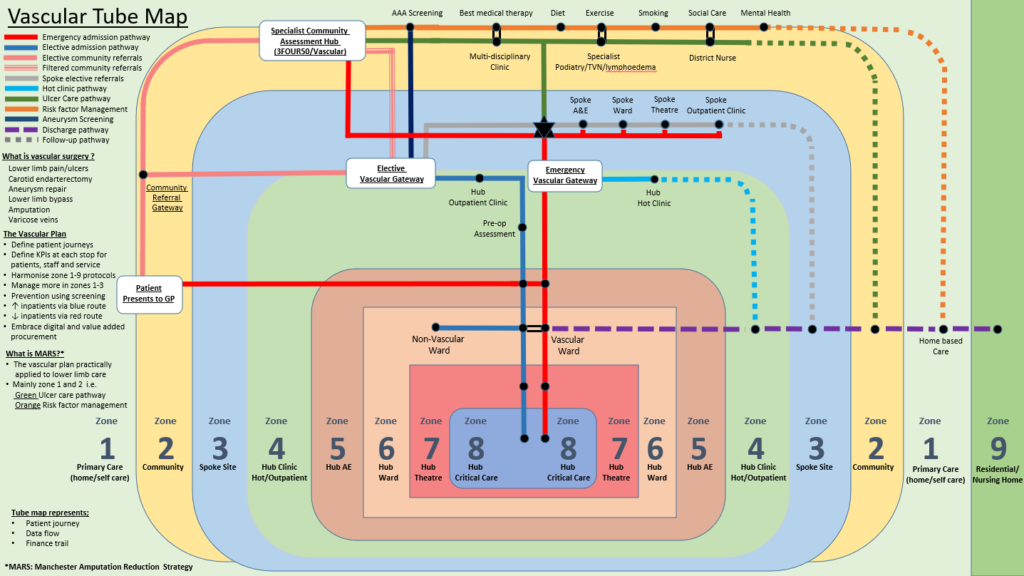
There have been brilliant examples published of how to do this. We could replicate the MARS tube map, or adapt the tiered approach to patient flow (with thanks to Nas Ahmed and team) [Figures 2 and 3].
There is a huge amount of thought that went into developing these pathways. Why recreate wheels? Instead, adopt and adapt to make these work for you. The structure is there and the model has been tested; it is evolving and growing, but can make a wider difference.
To do these things, we need to look up from the daily grindstone. At risk of repeating myself, this is not just a nursing problem; we need to hijack strategic priorities. We need to talk about deprivation, complex conditions, frailty and chronic long-term disease. We need to take the money where it exists, and engage commissioners to ensure that they understand the impact that wounds have at a population level, as well as an organisational level.
Most larger ICSs have a number of place-based partnerships that design and deliver integrated services for particular areas within the ICS. They involve a range of people interested in improving health and care, including the NHS, local councils, voluntary community, social enterprise and other local organisations, working alongside local people (NHS England, 2026).
If ever there were a condition that should sit at the heart of this approach, it is wound care. We can make this approach work nationally and locally, so let’s get started.
If you are thinking: ‘That’s all very well, but she doesn’t understand my role’, you may be right. I may not do your job now, and I accept that things have changed. But what has not changed — and what is not improving — is the experience and outcomes for our patients.
That is why we need to do something different. I will share more on how we can begin to make this shift happen in the next two issues of the journal.
In the meantime, have a great summer everyone.