The global burden of diabetic foot ulcers (DFUs) is a significant concern. Of the estimated 537 million people living with diabetes worldwide, between 19% and 34% are expected to develop a DFU in their lifetime (McDermott et al, 2023). The impact of DFUs go beyond physical complications, negatively affecting patients’ overall health and wellbeing. A study by Van Acker et al (2014) highlighted that individuals with active or recurrent DFUs experience significant reductions in physical and social functioning. This challenges the common misconception that pain is not a major issue in foot ulceration. In reality, pain, social isolation and a reduced ability to work all contribute to a lower health-related quality of life (HRQoL).
In addition to the human cost, DFUs place a significant financial burden on healthcare systems. Kerr et al (2019) estimated that DFU management costs the UK National Health Service (NHS) approximately £1 billion annually, representing around 10% of total diabetes-related spending.
Diabetes and the foot: aetiology and risk factors
Neuropathy and peripheral arterial disease (PAD) are among the most common complications of diabetes that contribute to the development of DFUs. Diabetic neuropathy, particularly sensory peripheral neuropathy, results in a loss of protective sensation, making it difficult for patients to detect minor injuries or damage to their feet (Monteiro-Soares, 2023). As a result, this absence of pain can delay detection and treatment. PAD, characterised by atherosclerotic narrowing of the arteries, can develop alone or alongside neuropathy.
It often remains undiagnosed until it progresses to chronic limb-threatening ischaemia, a condition marked by severe rest pain, gangrene or ulcers that do not heal within two weeks (Conte et al, 2019). The combination of PAD and neuropathy significantly increases the risk of developing a DFU which, in turn, increases the likelihood of infection and limb amputation (Crawford et al, 2015). The combination of PAD and neuropathy significantly raises the risk of ulceration, infection and subsequent amputation (Crawford et al, 2015).
Infections in diabetic foot care
Diabetic foot infections are serious complications of diabetes that often require hospitalisation and represent the leading cause of lower-extremity amputations (International Working Group on the Diabetic Foot [IWGDF], 2023). The increased risk of infection, particularly in those with neuropathy or PAD, highlights the importance of effective prevention and management strategies to mitigate severe outcomes, such as sepsis and amputation (IWGDF, 2023; NICE, 2024).
Patients with neuropathy are at especially high risk of infection, as the loss of sensation may result in both clinicians and patients overlooking early signs of injury and infection (Monteiro-Soares, 2023). While complete neuropathy results in a total loss of sensation, partial neuropathy may still allow some pain response, making it difficult to assess the true extent of foot damage (Pop-Busui et al, 2017).
Skin changes in diabetes
Diabetes is associated with a range of skin changes that compromise barrier function, including:
- Accelerated skin ageing and the production of advanced glycation end products, which cause irreversible damage to collagen fibres (Moraes et al, 2023)
- Reduced skin elasticity (Moraes et al, 2023)
- Skin thickening and stiffness, especially on hands and feet (Newton et al, 2018; Kaltheuner et al, 2018)
- Delayed wound healing and reduced skin integrity (Moraes et al, 2023)
- Skin discolouration.
These skin changes make patients more vulnerable to injury and infection. When the skin barrier is compromised, the risk of developing serious conditions like sepsis increases (Alexiou and Rau, 2023). This is especially important in people with diabetes, where skin changes combined with reduced sensation (peripheral neuropathy) place them at greater risk of skin breakdown.
One area of concern is the use of adhesive dressings for DFUs. These dressings need to stay in place for long periods, but their strong adhesive can make removal painful and potentially damaging to fragile skin. This can lead to medical adhesive-related skin injury, known as MARSI, which refers to any skin damage caused by medical adhesives, such as skin stripping, blistering or tearing.
To help prevent MARSI and minimise discomfort during dressing changes, podiatrists often use sterile medical adhesive removers. These products loosen the adhesive bond, allowing the dressing to be removed without causing further trauma to the skin.
What is a MARSI?
A MARSI occurs when the adhesive properties of medical products, such as dressings, tapes, electrodes, medication patches or wound closure strips, damage the skin. This damage can range from mild irritation to more serious injuries like skin stripping, blistering or skin tears [Table 1].
A MARSI typically happens during the removal of these products. Adhesives, particularly acrylic-based ones commonly used in medical products, form strong bonds with the skin that can strengthen over time. While this strong adhesion is necessary to keep dressings or devices securely in place, it can also increase the risk of skin damage when the product is removed. The bond can be so strong that removing the product can traumatically pull on the skin, leading to a MARSI.
These injuries can occur across various age groups and clinical settings (de Faria et al, 2022), particularly when correct techniques for applying and removing adhesive dressings or devices are not followed. Although all populations and clinical settings that use medical adhesives are at risk of a MARSI, especially with an increased frequency of exposure, certain patient groups are particularly vulnerable, including (Wounds UK, 2018; 2023):
- People with diabetes
- Extremes of age (paediatric or elderly patients)
- People with cancer
- People with dermatological conditions (e.g. eczema or psoriasis)
- People with oedema or whose skin is exposed to bodily fluids (e.g. urine, faeces, wound exudate or sweat) for prolonged periods
- People with fragile skin.
MARSI can cause significant pain, increase the risk of infection, prolong hospital stays and raise healthcare costs (Fumarola et al, 2020).
Skin stripping, a common type of MARSI, can lead to painful partial-thickness skin damage, which compromises the skin’s barrier function (Fumarola et al, 2020; Thayer, 2021; Bernatchez and Bichel, 2023; Figure 1). Once the epidermis has become compromised, the risk of infection is increased (International Wound Infection Institute, 2022) and is associated with pain and discomfort (Matsumura et al, 2012; Hofman et al, 2023).
A single-centre observational study in an adult acute care setting conducted by Farris et al (2015) reporting prevalence of MARSI found that daily prevalence ranged from 3.4% to 25%, with a mean 13%. Yet, MARSI is largely preventable with appropriate preventive measures, including the use of medical adhesive removers.
For at-risk patients, such as those with diabetes, a suitable skincare regimenn is essential for maintaining skin integrity [see Table 2]. This should include the use of skin protectors and medical adhesive removers, particularly sterile silicone medical adhesive removers, which have been shown to reduce infection risk, minimise the need for analgesia and decrease nursing time and costs (Fumarola et al, 2020).
Appeel® Sterile Medical Adhesive Remover
The use of a sterile medical adhesive remover, such as Appeel® Sterile Medical Adhesive Remover, is a key recommendation for clinical practice (Fumarola et al, 2020) particularly for patients with diabetes. It effectively removes adhesive and barrier film residues to minimise discomfort and skin damage, especially during dressing changes.
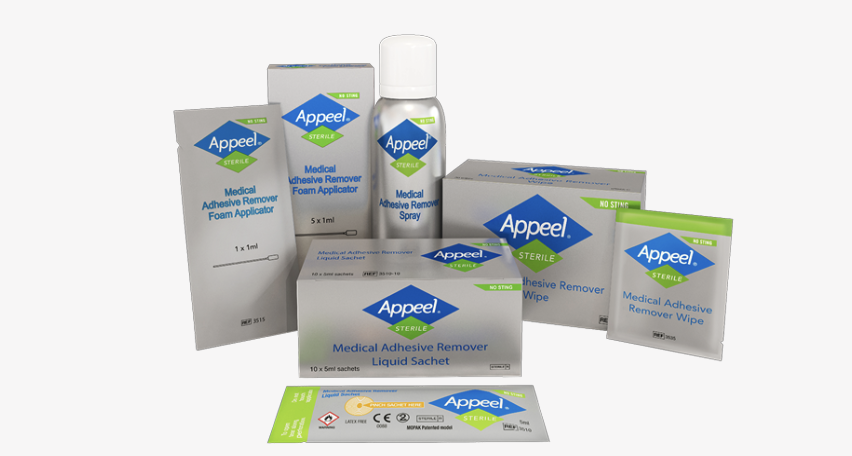
Appeel® Sterile is a non-sting medical adhesive remover that contains healthcare-grade silicone. Its formulation works by penetrating the space between the adhesive layer of the dressing or medical device and the patient’s skin to temporarily alter the surface energy of the skin. This mechanism loosens the adhesive bond, to allow for the safe and painless removal of dressings without compromising the integrity of the surrounding skin (Wounds UK, 2023). In a study of 155 patients, 85% experienced a significant reduction in pain or no pain at all when using Appeel® Sterile (CliniMed, 2010).
Appeel® Sterile products are fast-drying and leave no residue, ensuring quick and easy removal while preventing the accumulation of detritus around the periwound skin.
Appeel® Sterile is the only range of fully sterile medical adhesive removal products currently available in the United Kingdom and can be used on both intact and injured skin. It is especially beneficial for patients at significant risk of infection, such as those with open wounds, intravenous access sites/central lines and immunocompromised/suppressed individuals — e.g. people with diabetes.
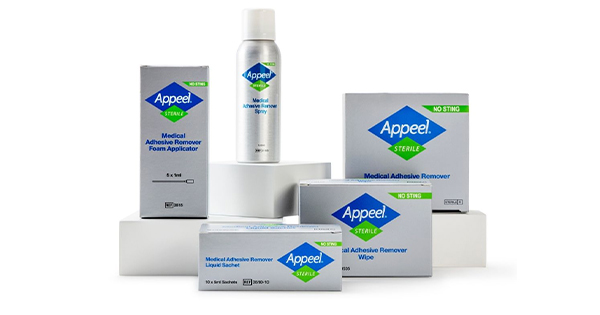
The product is easy to use and is available in a variety of formulations designed to suit a range of wound aetiologies. The range includes:
- Appeel® Sterile Liquid Sachet
- Appeel® Sterile Wipe
- Appeel® Sterile Foam Applicator
- Appeel® Sterile Spray (100ml).
Appeel® Sterile range in practice
The Appeel® Sterile range offers versatile options for skin care for people who have diabetes. The Appeel® Sterile wipe and foam applicator are ideal for removing small dressings. These products allow patients to be involved in their own dressing changes, fostering autonomy in care. Self-care positively impacts pain management, flexibility associated with patients’ own treatment regimen and the empowerment associated with being in control; responsibility for their own health also positively impacts patient HRQoL (Kapp and Santamaria, 2020). Patients who are involved in self-care gain a sense of control and responsibility over their health. This empowerment can enhance their overall well-being and engagement in wound care tasks like cleaning, dressing, and monitoring for infection (Blackburn and Ousey, 2023). The foam applicator enables precise removal in delicate areas, such as the periwound region in DFUs, where careful management of skin integrity is essential.
For larger dressings, the Appeel® Sterile Liquid sachet is an excellent choice. Its controlled delivery through a “pinch-top” technique ensures precise application, making it suitable for keeping the periwound area dry, which is critical for infection prevention in people with diabetes. The liquid sachet is cost-effective, as one sachet can efficiently remove large dressings using a start-and-stop technique, which is beneficial when dealing with fragile periwound skin.
A unique product in the Appeel® Sterile range is the single patient/multi-use spray. This spray is particularly useful for hard-to-reach wounds, such as diabetic foot or heel wounds. Its “Bag-on-Valve” technology allows 360-degree coverage, enabling healthcare professionals to apply it easily without awkward positioning. Notably, the spray does not cause a ‘cold sensation’ upon application, enhancing patient comfort. Ultimately, using a sterile medical adhesive removal product will assist in preventing periwound skin damage and reducing pain and discomfort experienced during dressing or medical device removal (Fumarola et al, 2020; Hitchcock et al, 2021). The product range and indications for use are summarised in Table 3.
Case study
The following case studies demonstrate the clinical application of Appeel® Sterile in supporting atraumatic dressing removal for patients with fragile skin, a common challenge in wound management. These examples illustrate Appeel® Sterile’s efficacy in reducing skin trauma and patient discomfort during dressing changes, particularly in individuals with underlying conditions such as diabetes and PAD.
Case 1, presented by Andrew Sharpe, Advanced Podiatrist and Academic Fellow in Podiatry at Northern Care Alliance NHS Foundation Trust, describes the use of Appeel® Sterile Spray to prevent skin stripping during dressing changes. Following its introduction, the patient’s reported pain decreased significantly, with Visual Analogue Scale (VAS) scores reducing from 8/10 to 3/10.
Cases 2 and 3, presented by Susan Artress-Brown, Principal Podiatrist and Diabetes Specialist Podiatrist at Hampshire and Isle of Wight Healthcare NHS Foundation Trust, demonstrate further applications of Appeel® Sterile. In Case 2, it enabled atraumatic removal of strongly adherent padding from bruised, vulnerable skin, where previous attempts caused microtears and discomfort despite neuropathy. In Case 3, it was essential for a patient with severe ischaemia and pain sensitivity, where conventional removal methods were stopped due to skin damage risk and intolerable pain.
Conclusion
In patients with diabetes and PAD, maintaining skin integrity and preventing infection are essential to avoid further deterioration. The use of Appeel® Sterile Medical Adhesive Remover can significantly reduce pain and skin trauma during dressing changes, thereby contributing to improved patient outcomes and enhanced adherence to treatment plans.