Breast and trunk lymphoedema present significant problems for women after breast cancer treatment (Riches et al, 2023; Ulman et al, 2024). A systematic review reported the incidence of breast oedema following breast-conserving surgery as ranging from 24.8% to 90.4% (Abouelazayem et al, 2021). However, research on breast oedema remains limited, with ongoing challenges in developing valid and reliable techniques to measure and quantify breast and trunk oedema (Fearn et al, 2022; Riches et al, 2023).
Breast-conserving surgery (e.g. wide local excision), axillary surgery, radiotherapy, larger breast size and higher body mass index are all associated with an increased risk of breast and trunk lymphoedema (Riches et al, 2023). The breast, adjacent axilla, back and chest may be affected due to shared lymphatic drainage pathways. Symptoms commonly include swelling, heaviness, hardness, redness, heat and discomfort at night, which often makes it difficult for women to find a comfortable bra (Williams, 2006; Todd, 2017; Hutton, 2024).
Ulman et al (2024) explored the experiences of 14 women with breast lymphoedema, reporting that many felt unprepared for these unfamiliar and distressing symptoms, which had a profound emotional and practical impact, particularly where their concerns were often dismissed by healthcare professionals.
The bra
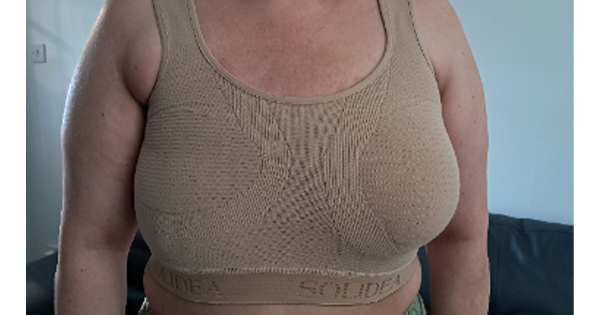
The Solidea® Silver Wave Skin Bra is a medical-grade compression garment with micro-massaging fabric, designed to promote lymphatic drainage and improve comfort [Figure 1, 2a, 2b].
Methods
Aim
To assess the effectiveness, comfort and qualitative experience of the Solidea® Silver Wave Skin Bra for women with breast and/or trunk lymphoedema following breast cancer treatment.
Ethical considerations
This was a pilot audit designed to gather feedback within the clinical context of a standard lymphoedema appointment. Ethical approval was not sought as this was part of routine care, but written informed consent was obtained from all participants, who were advised that they could withdraw at any point.
Methods
Women diagnosed with breast and/or trunk lymphoedema after breast cancer treatment were recruited through independent lymphoedema practitioners and a local breast cancer charity. At baseline (Time 1; Table 1), demographic and medical data were collected by an experienced lymphoedema nurse.
Audit data were collected through:
- Breast Symptom Assessment Score (clinician-completed at Time 1 and Time 2) using upper body diagrams [Figure 3]
- Self-Report Symptom Rating Scale (wearer-completed at Time 1 and Time 2; Figure 4)
- Wearer feedback (recorded at Time 2, with verbatim comments summarised as themes in the results section)
- Follow-up call (Time 3, by an independent clinician, to gather additional qualitative feedback).
The mean interval between Time 1 (baseline) and Time 2 was 26 days (range: 19–50). The mean interval between Time 2 and Time 3 was 11.25 weeks (range: 6–18).
Each woman was fitted with two Solidea® Silver Wave Skin Bras, according to individual measurements [Figure 2b], to allow women to wear a bra as much as possible, alternating if one was being washed. Women continued with their standard lymphoedema management (e.g. skin care, gentle exercise, occasional manual lymphatic drainage or self-massage).
Results
Of the 21 women recruited (mean age: 57 years; range: 41–75), 20 completed the audit to Time 2. One woman (wearer 17) withdrew due to undergoing additional breast cancer treatment. Twelve women were successfully contacted at Time 3.
Nineteen women (95%) had received radiotherapy. Of these, 73.6% had completed treatment within the last three years. Ten women (50%) had experienced oedema for 2–6 months, while the other 10 (50%) reported symptoms for more than 6 months [Table 1].
In terms of distribution, 14 women had both breast and trunk oedema (commonly swelling below the axilla and on the back). Four had breast oedema alone and two had trunk oedema only. The latter included:
- One woman with mastectomy and radiotherapy, awaiting fitting of a breast prosthesis
- One woman with bilateral mastectomy and DIEP flap reconstruction, who developed oedema of the chest wall below the breast.
Breast Symptom Assessment Score [Table 2]
At Time 1, the mean score across 20 women was 5.8/18 (range: 2–9). At Time 2, the mean score had reduced to 2.3 (range: 0.5–5), representing a 60% overall reduction. All women showed improvement, with the most marked change in wearer 15, whose score decreased from 9 to 1 (an 89% reduction). On the Breast Symptom Assessment Score, higher scores reflect greater severity of symptoms; therefore, a reduction indicates clinical improvement.
Self-Report Symptom Scale [Table 3]
At Time 1, the mean score for 20 women was 6.85/18 (range: 3–12), reducing to 3.4 (range: 0–8) at Time 2. All scores reduced, with a 50% reduction in the mean across the cohort. This included:
- Reduction in the numbers reporting moderate to severe swelling from 14 women (70%) to three (15%)
- Reduction in reported breast hardness from 18 women (90%) to 13 (65%)
- Reduction in reported night-time discomfort from 17 women (85%) to nine (45%).
On this patient-reported scale, higher scores similarly denote greater symptom severity, so a reduction indicates perceived improvement.
Wearer feedback score [Table 4]
At Time 2, mean scores for most items were greater than four out of five. Degree of support scored lowest, with a mean of 3.3.
All participants rated the bra’s comfort as “excellent” or “good.” Similarly, 90% rated ease of application/removal as “excellent” or “good.” All 20 women continued to use the bra throughout the study and all 12 women contacted at Time 3 confirmed they were still using it.
Qualitative feedback
Women provided detailed insights into their experience of wearing the bra, with three key themes summarised below:
Theme 1: Effectiveness and comfort
When first fitted with the bra, all women commented on the comfort of the garment, in comparison to other bras they were using. Reported improvements included softening of breast tissue, reduced swelling and improvements in pain. In one woman post-mastectomy, the bra was effective in reducing lymphoedema on her back and chest wall prior to her being fitted with a prosthesis [Figure 5].
Wearers comments:
- ‘There is less swelling and it does keep the lymphoedema under control; pain is less and it is more effective than my foam insert’
- ‘I have less swelling and there is a noticeable improvement in swelling at the end of the day; I will continue wearing the bra and would highly recommend’
- ‘The swelling has definitely improved; the bra is very comfortable and nice to wear; it washes easily and stays fresh’
- ‘I am very happy with the bra — it seems to do the massage that I would normally do; my breast feels softer’
- ‘This is this was the most comfortable bra compared to others and I can even put my small prosthesis inside to even up the sizes’
- ‘I noticed a difference almost straightaway and was surprised at the improvement. My breast is less hard and the skin feels more flexible’
- ‘The swelling is almost fully away; the bra texture and fit is excellent despite me having a mastectomy’
- ‘The orange peel look has gone’
- ‘I do like the fabric as it is soft and comfortable and feels sporty; it is good to have no seams to cause discomfort’
- ‘I am very happy with this bra and am wearing it most days’
- ‘The material is soft and flexible’
- ‘It is much more comfortable than the bra given to me after surgery’.
Theme 2: Useful at night
By Time 2, 10 women reported wearing the bra regularly overnight. One woman summarised her thoughts on the bra, reflecting on returning home after a busy day at work:
‘I love it; it is part of my routine now. In the evening I have a shower, do massage and put on the bra. It is like a second skin. I go to bed and don’t think about the swelling. I tried lots of different bras in the last few months and some wrinkle or move up, or the straps fall down; this bra is really comfortable. It is like putting on my safety blanket’.
Three women reported the bra felt hot during warmer nights but continued to wear it. The relief for women when they noticed changes in symptoms was evident:
- ‘I wake up in the morning and swelling has gone – it previously felt like a constant tennis ball under my arm; it is definitely less in the morning after wearing overnight’.
Theme 3: Limited support and shaping for larger breasts
The main problems reported in the audit were lack of support from the bra for larger-breasted women. This made it difficult for some women to wear the bra during the daytime while out of the house or when exercising. Comments included:
- ‘The band and shoulder straps have too much give; the cup sizes could be larger and provide more separation; my breasts were squashed in the middle with pooling in the centre, and I could not exercise in it is not supportive enough’.
- ‘It rides up as cup does not fit on my breast. Then I started wearing [it] at night and am pleased with the changes as my breast is smaller’.
- ‘There is not enough support for brisk walking or exercising’.
- ‘The support is not quite enough but I have worn the bra all the time for last few weeks as it is very comfortable and effective’.
Discussion
Difficulties with restrictive bras highlights the need for more lightweight alternatives (Hutton, 2024). This audit demonstrates that the Solidea® Silver Wave Skin Bra provides a clinically effective, safe and comfortable option for women.
Women were overwhelmingly positive about trying the bra, particularly given the lack of other options for managing distressing symptoms. Of the 19 participants who had undergone radiotherapy, 26.3% were more than 3 years post-treatment, reflecting the potentially chronic nature of breast or trunk lymphoedema.
The Solidea® Skin Bra’s unique wave textured pattern provided clinical changes in the tissues even over a short period of wear. Changes in symptom scores showed significant reductions and qualitative feedback provided further insights for health professionals and industry. The audit provides indications to guide professional decision-making, suggesting the bra is suitable for:
- Early treatment of breast lymphoedema and support after mastectomy, local excision or breast reconstruction
- Ongoing maintenance care, including day- and night-time wear in women with lymphoedema of the breast and trunk
- Daytime use in women with smaller breast cup sizes
- Night-time use in women with larger breast cup sizes.
Challenges were identified for larger-breasted women, particularly regarding adequate support. Table 1 indicates that 80% of women had a bra cup size greater than D. A supportive bra is identified as key in helping women to manage breast oedema (Hutton, 2024). In response to feedback during the audit, the manufacturer developed a vest garment from the same material for a woman post-mastectomy and deep inferior epigastric perforator (DIEP) flap reconstruction. This vest provided additional support to the breast and helped soften oedema and fibrotic tissue beneath the reconstructed breast.
Limitations
This audit relied on clinical assessment and self-reported symptoms, which remains the most practical approach for a pilot study. Previous studies have explored the use of ultrasound, tissue dielectric constant and tissue tonometry for quantifying breast and trunk lymphoedema (Fearn et al, 2023; Riches et al, 2023). Future research could incorporate these objective measurements, alongside validated tools such as the BrEQ (Dutch Breast Edema Questionnaire; Verbelen et al, 2020).
While 65% of the women were receiving manual lymphatic drainage and 70% were undertaking self-massage, these interventions may have contributed to observed improvements. Nevertheless, this reflects standard clinical practice in comprehensive breast and trunk lymphoedema management.
Conclusions
Breast and trunk lymphoedema remain a problem despite advances to reduce the risk (Falco et al, 2020). The Solidea® Silver Wave Skin Bra offers a comfortable and effective intervention for managing breast and trunk lymphoedema, suitable for both daytime and night-time use. The findings provide valuable insights for future research and product development.
Future work should explore improvements in bra design to enhance support, provide larger cup sizes with better shaping and separation and accommodate women who wear prostheses. Further research is warranted to evaluate the Silver Wave design and its potential clinical benefits more broadly.