
Provision of standardised care is crucial across health care for ensuring consistent, safe, high-quality, efficient and evidence-based practices for patients, with the aim of ultimately improving patient outcomes. Developing and embedding care pathways that standardise procedures contributes to adherence to best practices, reduces variability in treatment and encourages collaboration among health care teams (Sen, 2024).
Within wound care, standards and practices can vary considerably. This can depend on the care setting, geographical area, wound care education and availability of products, among other factors. This can result in confusion for clinicians and inequity of outcomes for patients, that may be further influenced by demographic differences, psychosocial and socioeconomic factors, patient capacity and access to care.
Standardised care pathways
It has been identified that a key factor in reducing unwarranted variation in the assessment and treatment of wounds is the implementation of patient focussed wound care initiatives through clinical pathways (Adderley et al, 2017).
While there is no universal solution to reducing or removing variation in clinical practice, greater standardisation should be led by structured guidelines and pathways to focus wound assessment and management (WUWHS, 2020a). This includes accurate and thorough assessment of wounds and holistic assessment of individual patients, triggering diagnosis and appropriate care pathways that include ongoing monitoring and documentation.
- Assessment should be the starting point and foundation of care. Full patient wound assessment:
- Addresses the underlying cause(s)
- Identifies the barriers in wound healing at the point of assessment and every evaluation
- Allows for the documentation of wound status
- Facilitates tracking changes in the patient and their wound(s) over time
- Provides a foundation for the collection of wound progress and outcome data
- Informs appropriate treatment planning
- Enables the patient and their carers or families to recognise and appreciate the progress or deterioration of their wound
- Provides data for policy-makers (WUWHS, 2020a).
Pathways need to be evidence-based, informed by best current knowledge, while still being flexible enough to be tailored to the individual patient, their wound, general health and circumstances. It is important to translate evidence and research into practice to improve outcomes (WUWHS, 2020b). Evidence-based practice combines clinical expertise, the latest and best available evidence and the patient’s unique circumstances and value systems, to standardise practice and improve patient outcomes (Abu-Baker et al, 2021).
Clinical knowledge and training
The successful implementation of structured assessment tools and care pathways depends on clinician training and knowledge. For clinical pathways to be effective, professional development is required (Moore and Delahunty, 2023). The healthcare professionals providing wound interventions need to have relevant and up-to-date evidence-based knowledge to deliver the care effectively, in a timely manner and in the right place. Nurses in the United Kingdom (UK) are required to engage in continuous learning to maintain competence in line with their professional body (Griffith and Tengnah, 2020).
Implementation also depends on communication and ‘buy-in’ from all team members and stakeholders. This may take time and require changes in mindset (away from ritualistic practice or practice based on ‘this is the way we have always done it’), which needs openness and communication within teams. It is essential for healthcare organisations to create and embrace an open culture in which staff feel able and supported to speak out and share concerns (Department of Health, 2015). The establishment of a lifelong culture of learning is essential and education related to effective wound care and product selection should be offered to all staff (Fletcher et al, 2023).
In turn, having structured pathways to inform care can increase clinician confidence in practice, providing a framework for decision-making and appropriate patient care.
The lower limb
Guest et al (2015) identified the need to reduce unwarranted variation in the assessment and treatment of wounds across the patient pathway. This work found that 12% of all wounds had no diagnosis and it was not possible to infer a wound type from the patients’ records. Additionally, 19% of all wounds were a leg ulcer without any further characterisation or description (i.e. venous, arterial or mixed). In total, there were 730,000 leg ulcers which equated to 1.5% of the adult population having a leg ulcer in the study year. The number of diagnosed venous leg ulcers (278,000) indicated that 1 in 170 adults had such an ulcer in the study year.
Assessment of peripheral perfusion is a recognised requirement for leg ulcer and diabetic foot management, yet only 16% of all cases with a leg or foot ulcer had a Doppler ankle brachial pressure index recorded in their records (Guest et al, 2015).
Further work by Guest et al (2020) found that the annual prevalence of wounds had increased by 71% between 2012/2013 and 2017/2018. There was a substantial increase in resource use over this period and patient management cost increased by 48% in real terms, further highlighting the need for improved care and standardised pathways to improve outcomes.
National Wound Care Strategy Programme
The National Wound Care Strategy Programme (NWCSP) was developed to improve the care of wounds, highlighting the unwarranted variation in UK wound care services (NWCSP, 2020). Major opportunities have been identified to improve healing rates, thereby reducing patient suffering, the use of inappropriate or ineffective treatments, and the amount of clinical time devoted to wound care.
The NWCSP defines lower limb ulcers as wounds on the lower leg (below the knee) and foot that are slow to heal, with the biggest proportion of leg ulceration due to venous insufficiency. The NWCSP lower limb recommendations are based on robust evidence to support the use of compression therapy (O’Meara et al, 2012) and endovenous surgery (Gohel et al, 2018) as first-line therapies to promote healing of venous leg ulceration. See Box 1 for further evidence and statistics on healing rates highlighted by the NWCSP.
The NWCSP lower limb recommendations aim to encourage equitable and accessible services for leg ulceration, reducing unwarranted variation of care, increasing the use of evidence-based care and discouraging the over-use of therapies for which there is insufficient evidence (Gray et al, 2018), resulting in higher healing rates.
The recommendations by the NWCSP signpost to relevant clinical guidelines or outline evidence-informed care that aim to improve healing and optimise the use of healthcare resources. The recommendations outline a pathway of care that promotes rapid diagnosis, enabling fast access to appropriate therapeutic interventions, with swift escalation of treatment or service provision for patients requiring more complex care.
The NWCSP recommendations thus offer a framework for the development of local delivery plans that includes consideration of:
- Relevant research evidence (where it exists) to inform care
- Configuration of services and deployment of workforce
- Appropriate education for that workforce
- Relevant metrics to measure quality improvement.
Standardising and improving practice in Hull and East Riding
City Health Care Partnership (CHCP) and Hull University Teaching Hospitals NHS Trust (HUTH) embarked on a project to standardise wound care practices in Hull and East Riding, following the NWCSP lower limb recommendations.
Before the project, there was no clear pathway for treating lower limb wounds, leading to inequities in care. Partnering with Essity, they developed clinical pathways, transformed practices and provided comprehensive staff training.
As a first tranche implementation site for the NWCSP lower limb project, CHCP and HUTH focussed on:
- Engaging teams to understand current processes
- Analysing patient assessment, treatment and referral
- Standardising clinical pathways
- Educating clinicians about changes.
A project team initially worked with Essity’s strategic team to develop a six-step project proposal [Figure 1]. This identified and outlined the initial aims and areas requiring development, taking a step-by-step approach to define the overall project and actions required.
Developing the lower limb pathway
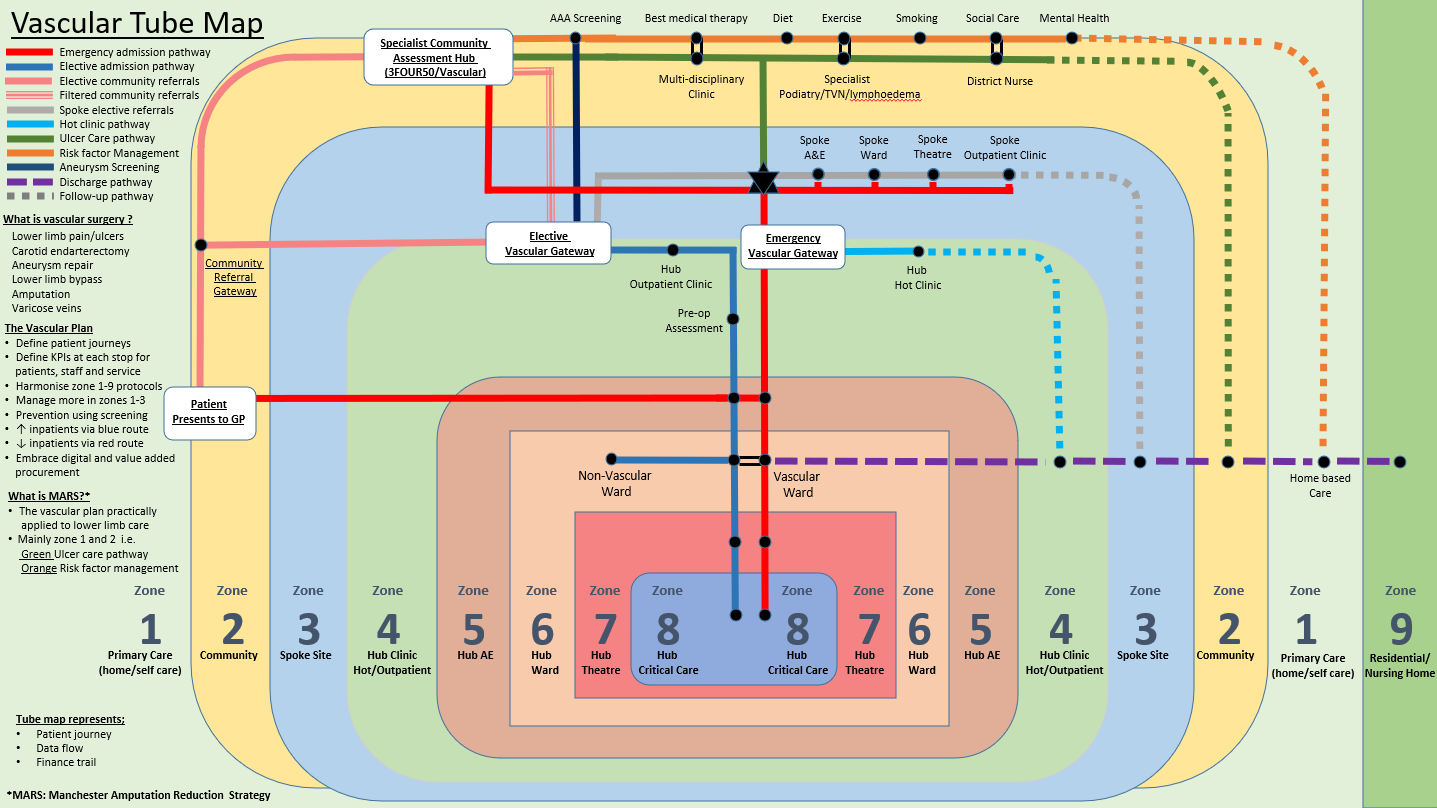
The NWCSP recommendations highlight the importance of strong compression therapy for leg ulcers with adequate arterial supply. CHCP and HUTH worked in partnership with Essity’s strategic team to develop a fully integrated lower limb pathway based on the NWCSP recommendations [Figure 2].
This pathway provided a structured framework to increase staff confidence and ensure care was standardised and evidence-based. Use of the pathway in practice also facilitated seamless referrals from community podiatry and nursing services to HUTH vascular services. This led to improved patient outcomes and system-wide benefits, through implementing the standardised and evidence-based recommendations.
As the need for standardised care pathways had been identified, additional pathways were developed, including pathways for:
- Infection management
- Exudate management
- Cleansing protocols.
In line with recommendations for compression therapy, CHCP additionally implemented the Essity JOBST Online electronic ordering system to enable staff to select and access appropriate compression garments during first assessment clinics.
Improvements in practice
The CHCP-HUTH Lower Limb Pathway ensured prompt assessment, treatment and management of 100% of patients with lower limb ulceration. Patients were then able to access the appropriate compression therapy, as clinicians were informed about best practice and the need for compression where possible. Table 1 provides more information on patient assessments under the Lower Limb Pathway.
Healing rates
Overall healing rates for both leg and foot ulceration were found to improve under the Lower Limb Pathway, and with increased awareness and use of appropriate compression therapy for patients.
At 24 weeks, 72% of leg ulcers and 79% of foot ulcers had fully healed [Figures 3 and 4].
Conclusion
This article highlights the remarkable success of the CHCP-HUTH Lower Limb Pathway developed in partnership with Essity in achieving the aims of the NWCSP. This initiative significantly reduced variations in care, alleviated patient suffering and increased healing rates. The direct referral system to HUTH Vascular Service from first assessment clinics and home visits proved to be phenomenally successful, benefiting the entire healthcare system, particularly GPs and primary care providers.
Key improvements from the partnership with Essity included:
- Reduced spending on ineffective treatments: By implementing evidence based practices, the project minimised the use of ineffective treatments, leading to cost savings
- Improved urgent referral processes to vascular services: Streamlined referral processes ensured that patients received timely and appropriate care from vascular specialists
- Implementation of Essity’s ‘Off Script Model’, JOBST Online: This digital solution reduced GP prescription requests, primary care appointments, dispensing costs and clinical time spent on wound care, enhancing efficiency
- Enhanced equitable care and patient putcomes: Standardised pathways ensured that all patients received consistent and high-quality care, improving overall health outcomes
- Promoted patient self-management and self-care: Empowering patients with the knowledge and tools to manage their conditions led to better self-care practices and reduced dependency on healthcare services
- Improved sustainability: The project contributed to environmental sustainability by reducing bandage waste, CO2 emissions from home visits, clinic appointments and GP visits.
Throughout the project, CHCP received positive feedback from stakeholders, underscoring the success and impact of the initiative.