Each year, the NHS treats more than 2.2 million chronic wounds, with an annual cost of £5.3 billion attributed to their management and related comorbidities (Guest et al, 2015; 2020). Furthermore, Guest et al (2020) found that 59% of chronic wounds healed in the absence of infection, whereas the healing rate dropped to 45% when infection was either confirmed or suspected. Globally, approximately 8 million people are affected by wounds, with or without infections (Sen, 2018). Costs increase when there are unwarranted variations in care.
Unwarranted variations can significantly impact both patients and healthcare systems, leading to heightened patient risk, increased strain on resources, rising costs, disparities in clinical outcomes, and a decline in quality-of-life measures (Atsam et al, 2020). Discussion surrounding unwarranted variation is not new. Mays (2011) reported that variations in the NHS had been set out in the NHS Atlas of Variation; Lord Carter (2016) estimated that by reducing unwarranted variation, at least £5bn of the £55.6bn spent annually by acute hospitals could be saved. Reducing unwarranted episodes of care is a central aim of healthcare improvement initiatives, such as the Getting It Right First Time (GIRFT) programme, which seeks to improve patient outcomes and optimise resource use, thereby delivering value-based healthcare (NHS England, 2021).
Through minimising unwarranted episodes of care, healthcare systems can optimise patient safety, improve resource allocation, and enhance overall efficiency. Patient safety has been identified as a global health priority (World Health Organization, 2018), with the NHS being required to investigate these unintended or unexpected events, which include omissions in care that could have or did harm one or more patients (NHS England, 2022a).
Wound infections can slow the healing process, intensify pain, diminish quality of life, and place a considerable burden on healthcare services. To prevent this, the Tissue Viability Team at South Warwickshire University NHS Foundation Trust (SWFT) established a clinical pathway to ensure effective, timely, cost-effective and evidence-based management of wound infections.
A clinical pathway is a structured plan used to detail essential steps in the care of patients (Rotter et al, 2010) using evidence-based care with the aim to translate practice guidelines into clinical processes (Rotter et al, 2019). These pathways assist in minimising variations in clinical practice. Ultimately, enhancing patient outcomes and optimising clinical efficiency and should be embedded as a standard approach to care delivery if there are to be sustainable improvements for patient outcomes (Phillips, 2025).
The pathway
The pathway was designed to provide a simple and easy to use guide for the diagnosis and treatment of wound infections offering guidance on product choice throughout each stage of the wound infection continuum. Implementing an evidence-based pathway to enhance and ensure equitable care in wound infection align the principles outlined in Lord Darzi’s independent review of the NHS in England. His findings emphasised the critical role of standardisation and evidence-based practices in strengthening the healthcare system, highlighting the ongoing inconsistencies in the quality of care (Darzi, 2024).
The Tissue Viability Team at SWFT introduced UrgoClean Ag as part of the pathway, a multidimensional product that facilitates continuous wound cleansing and debridement, while providing antimicrobial protection. This was due to evidence showing the product to be an interactive multidimensional dressing featuring a TLC-Ag matrix that transforms into a gel upon contact with wound exudate, fostering a moist environment conducive to healing (Dowsett, 2023). At the same time, its hydro-desloughing polyacrylate fibres efficiently absorb excess exudate adhering to sloughy residues, enhancing the continuous autolytic debridement process (Meaume et al, 2012; 2014).
Wound dressings are designed to support the local wound environment and facilitate healing. Simple or passive dressing types primarily serve as a protective barrier, preventing further damage, while maintaining optimal moisture levels. Whereas more advanced interactive dressings can modify the wound’s physiological environment to optimise healing by promoting debridement, enhancing granulation tissue formation and re-epithelialisation and managing exudate levels and bacterial load (Holloway and Harding, 2022).
The pathway was disseminated to all staff members across SWFT to provide a structured approach to managing wound infections, ensuring consistency and effectiveness in treatment [Figure 1]. Structured frameworks and pathways play a crucial role in reducing disparities in care and advancing health equity, ensuring that patients receive timely access to appropriate treatments and products. To maintain efficiency in clinical practice, these frameworks should be clear and well-organised, designed to optimise workflows rather than add unnecessary complexity for healthcare professionals.
However, despite the pathway being introduced across SWFT, the Tissue Viability Team identified an increase in antibiotic requests and number of referrals relating to wound infection management. Upon investigation, it became evident that the pathway was not consistently applied in clinical practice. Nevertheless, the increase in reported wound infection incidents did not reflect a decline in the quality of care. Instead, it demonstrated an enhanced awareness and a strengthened culture of safety, where staff were more empowered to report and learn from incidents through structured processes.
By embracing the PSIRF approach, SWFT has proactively shifted toward a system-wide learning, fostering continuous improvement and better outcomes for patients. This reflects a commitment to transparency, accountability and high standards of patient care.
Patient Safety Incident Response Framework
To enhance patient safety responses, NHS England (2022a) introduced the Patient Safety Incident Response Framework (PSIRF), offering guidance on fostering a culture, systems, and behaviours that enable the NHS to effectively address patient safety incidents, ensuring lessons are learned and improvements are enacted.
Patient safety has been identified as a global health priority (World Health Organization, 2018). Implementing the PSIRF framework through the use of swarms supports learning aligned with Tanner’s Clinical Judgement Model, which highlights how nurses think and make decisions in complex, uncertain clinical situations that demand sound judgment (Tanner, 2006). Although centred on student nurse learning, the model identifies areas where breakdowns may occur, enabling others to provide feedback and coaching to help gain insight into clinical thinking. This approach facilitates targeted clinical learning activities that strengthen skills in clinical judgment. By promoting collaborative, real-time discussions, PSIRF swarms have enabled staff to concentrate on constructive learning rather than attributing blame, thus optimising investigative processes and enhancing patient safety outcomes.
At SWFT, a key aspect of fostering a learning culture and improving understanding of the wound infection pathway involves conducting a mini-investigation. This process seeks to establish whether the omission of the pathway represents a learning opportunity or resulted in moderate harm. When such insights or instances of harm are identified, the Tissue Viability Team promptly initiates a swarm following a patient safety incident to facilitate learning and drive improvements in practice. Immediately following an incident, clinical staff gather at the site to rapidly assess what transpired, understand the contributing factors, and identify necessary actions to reduce risk (NHS England, 2022b).
To promote learning from patient safety incidents swarm-based huddles are held on a Tuesday and Thursday lunchtime via Microsoft Teams (they can be rescheduled depending on staff availability), and recurring invitations are sent to all leads and the swarm panel. However, they only need to attend if they have had prior notification from the Tissue Viability Team. The swarms enable staff to swiftly analyse the event, understand its causes, and determine necessary actions to mitigate risks and facilitating rapid insights and reflections (NHS England, 2022b). A specific incident revealed that the wound infection pathway was not being applied effectively in practice and was used as a learning aid during the swarms.
Case study
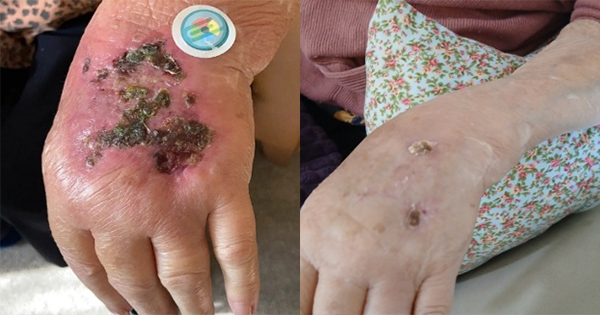
An 80-year-old woman, diagnosed with dementia, had been discharged from hospital to a community care home with a wound to her hand, caused by a cannula which had been present for 3 days. Her wound had been left uncovered, and she had not been started on the wound infection pathway prior to discharge. She was referred to the Tissue Viability Team for assessment. On assessment there were local signs of clinical infection, and she reported high levels of pain. She could not tolerate cleansing of the wound or debridement of the scabs [Figure 2]. The Tissue Viability Team commenced the wound infection pathway during their first visit.
UrgoClean Ag was applied, as per the pathway, to facilitate debridement and effectively manage the infection with its fast-acting silver formulation. The Tissue Viability Team reviewed the wound the following day and noted signs and symptoms of wound infection were reducing. There was clear evidence of debridement, and the patient reported reduced wound pain. However, despite the decrease in pain, she remained unable to tolerate wound cleansing. Treatment was maintained as per the pathway.
By day 9 there was evidence of further debridement; erythema and signs and symptoms of infection were reducing. The patient reported a significant reduction in wound pain, though she remained unable to tolerate wound cleansing. By day 12, the wound continued to improve. All signs and symptoms of wound infection had gone, pain levels had significantly reduced, and the wound was almost healed. UrgoClean Ag was discontinued at this point. The wound improved and healed within 5 weeks after assessment and commencement on the wound infection pathway.
Improvement plan
After implementation of swarms and recognition that the wound infection pathway was not being effectively implemented in practice, an improvement plan was initiated to enhance staff knowledge and competency [Table 1]. The improvement plan was implemented across the community division which including case studies in wound management training and raising awareness in the PSIRF quality implementation group so that system wide learning could take place.
The case study demonstrated the dressing’s ease of use due to it being multidimensional with the ability to effectively and continuously debride and manage infection, and the positive clinical outcomes associated with the pathway. Through the consistent delivery of swarms focusing on wound infection management, staff reported increased confidence in handling infected wounds and adhering to the pathway. The integration of the case study enabled clinicians to visualise wound progression and identify key indicators for both improvement and potential deterioration.
It was concluded that as the pathway had been implemented at initial wound assessment, clinical outcomes had been enhanced, leading to cost savings by reducing the need for frequent nurse visits and prolonged use of numerous wound care products. Selecting the right dressing for the right patient at the right time should be a fundamental practice, with every possible step taken to ensure appropriate wound bed preparation, guided by evidence and tailored to the patient’s specific needs (Dowsett, 2023).
A key outcome of using the PSIRF and swarms has led to an enhanced system-wide perspective on learning. By moving away from isolated learning within individual teams or departments, the Tissue Viability Team now facilitate learning across the entire division. Training and education is essential and key to increase familiarity with products available on formulary and to support appropriate use of antimicrobial dressing and contribute to antimicrobial stewardship. This has resulted in greater collaboration, consistency, and shared best practices, ensuring that lessons learned are not confined to specific incidents or local teams but are instead embedded at a wider organisational level. Furthermore, we have gained a deeper understanding of how to support and train staff more effectively, helping to create a workforce that feels empowered and well-equipped to drive continuous improvement in patient care.
Conclusion
Optimising wound infection management can be achieved through implementing and embedding an evidence-based clinical pathway to enhance patient outcomes and health equality. Early implementation of the pathway at the initial wound assessment improved clinical outcomes, reduced nurse visits, and minimised the prolonged use of multiple wound care products, resulting in cost savings. Implementing PSIRF Swarms has ensured that staff feel heard, valued, and engaged in meaningful learning. By shifting the focus from blame to improvement, a culture can be cultivated where learning is proactive, system-focused, and impactful, ultimately enhancing both patient safety and staff wellbeing. The multidimensional mode of UrgoClean Ag through supporting cleaning and debridement of the wound, the product provided a simplified approach to wound bed management and management of wound infection and can be used safely by all clinicians.