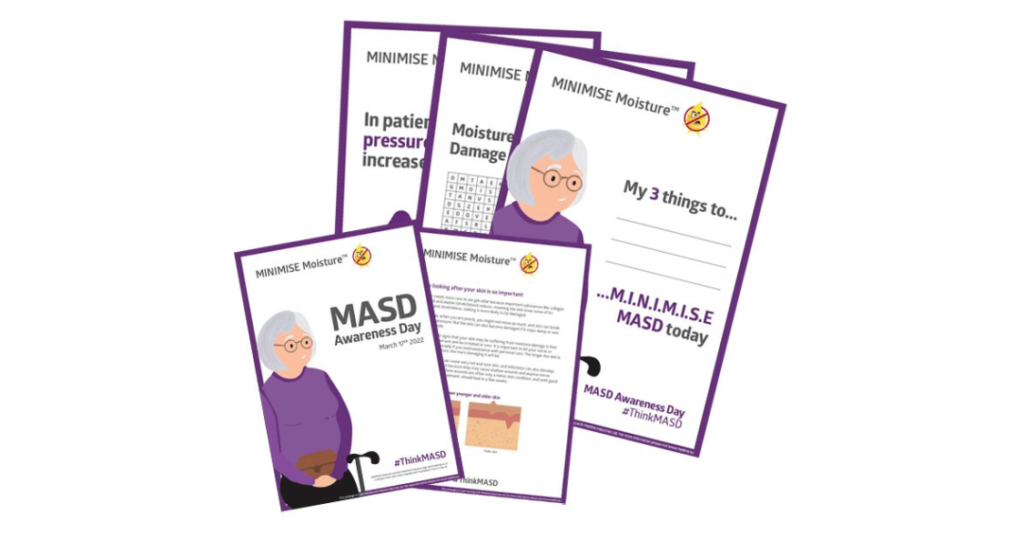
We are fast approaching the next National Moisture-Associated Skin Damage (MASD) Awareness Day in March 2026. After a successful local campaign called ‘MINIMISE Moisture’ at Liverpool Heart and Chest NHS Foundation Trust (Tyrer, 2020), Tissue Viability Nurses worked with Medline, our industry partner, to create a new national awareness day for MASD. MINIMISE was an acronym compiled after a review of the current literature and best practice of MASD, and summarised the key considerations in the prevention of MASD.
What does MINIMISE stand for?
- Management of incontinence – making the right choice at the earliest opportunity.
- Inspect the skin – checking all areas that can be affected by urine, faeces, sweat and wound fluid.
- Nutrition – importance of nutrition in maintaining skin integrity.
- Implement a plan for the prevention/management of MASD for at-risk patients.
- More moves – changing position aids evaporation of moisture and cooling.
- Identify MASD correctly – understanding the differences between pressure and moisture damage.
- Skin care – importance of skin care protocol for at-risk patients.
- Educate – staff who you work with and patients – about actions they can take to reduce the risk of MASD.
MASD Awareness Day aimed to bring a specific focus to MASD and to complement the existing Stop the Pressure Day. In March 2021, we led the first MASD Awareness Day. At that time, we were experiencing a high incidence of MASD and observing the negative impacts on patients, in a similar way to those caused by some pressure ulcers.
In recent years, MASD has become more recognised as a significant cause of skin damage in its own right. It develops from prolonged exposure of the skin to moisture and irritants, such as urine, faeces, intestinal fluids, digestive secretions, mucus, saliva, perspiration and wound exudate (Wounds UK, 2025).
There are four main types of MASD:
- Incontinence-associated dermatitis (IAD) – caused by urinary and/or faecal incontinence.
- Intertriginous dermatitis (intertrigo) – where two areas of skin are in contact with one another.
- Peri-stomal moisture-associated dermatitis.
- Peri-wound moisture-associated dermatitis.
How big is the problem?
There are currently no ongoing national data available on the prevalence of MASD, so the size of the problem is unknown. However, in a national point prevalence audit of more than 10,000 patients, 587 patients were observed to have MASD, so a prevalence of 5.87% (Stephenson et al, 2021). This is equivalent to 64% of the observed prevalence of pressure ulcers (9.04%), which are considered nationally to be a significant patient harm attracting much strategic attention, suggesting MASD also requires attention.
Local tissue viability nurse colleagues in the region also continue to report an ongoing issue with trying to reduce the number of incidents of MASD within their organisations. To be able to better understand the extent of the problem, a short survey has been compiled, which organisations are asked to complete and submit:
https://forms.office.com/pages/responsepage.aspx?id=Tkew1qsUu0GtvYw5-PIVgtoxmuZBbkJHrDZJW4uog-FUQUlKMlY5WFRZRklGOThKVzJIMVBCUTdZQS4u
The data will be collated and shared after this year’s MASD Awareness Day.
Best practice
Wounds UK (2025) has recently published an updated Best Practice Statement: Understanding types of moisture-associated skin damage (MASD): prevention, identification and management. This aims to provide practical guidance to support best practice in the prevention and management of MASD to reduce incidence and improve patient outcomes. The following case studies and photographs highlight the impact of MASD on patients.
Case study 1
A 64-year-old female patient, 3 days post-cardiac surgery in the intensive care unit, ventilated and sedated. She developed type 7 liquid stools (Bristol Stool Chart). Staff identified IAD [Figure 1] and immediately started a management plan, including the use of an advanced skin barrier product. Unfortunately, even though she had been identified as being at a higher risk of developing MASD, earlier signs of IAD had not been seen, and an effective prevention plan had not been implemented at an earlier opportunity. This case demonstrates the importance of identifying patients at risk and planning and implementing an appropriate care plan, including a skin cleanser and barrier product, with close skin inspection.
Case study 2
A 72-year-old female patient, who had recently been catheterised for urinary incontinence, was asked to be reviewed by the tissue viability nurse. She was also wearing an incontinence pad as the catheter had been bypassing. She described her skin as ‘’burning.’
Due to some miscommunication about who was attending to the patient’s hygiene that morning, no one had assisted her, and on arrival, her incontinence pad was saturated and her skin extremely excoriated [Figure 2]. It was difficult to determine from the patient’s record how long she had been seated and wearing a wet pad. She appeared to have an appropriate prevention plan in place, including skin cleanser and barrier cream. However, it was not clear when the skin was last cleansed or the barrier cream last applied. Early recognition of MASD and an appropriate skin care regime is needed in order to prevent MASD (Wounds UK, 2025). This incident prompted a change in the electronic patient record to support more accurate documentation of the preventative plan and products applied.
A preventable harm
Arguably, MASD should be considered as a preventable harm. Accurate and timely assessment is essential for the prevention and management of MASD. This includes close and regular skin inspection, which is key in identifying early signs of MASD, as it is for pressure damage (Wounds UK, 2025). All organisations are encouraged to participate in this year’s MASD Awareness Day to promote these key messages.
New resources for MASD Awareness Day
Our digital campaign kits will be available to download, with posters and other resources, which organisations can tailor by adding their own logo. Complete the registration form below to receive your digital campaign pack for your local MASD Awareness Day.
https://www.medline.eu/uk/knowledge-base/masd-awareness-day
Stay informed about the latest updates on MASD Awareness Day by following us on X/Twitter: Continence UK and Harm Free Care Network UK
@TV_LHCH
@harmfreecareuk
@continenceuk
MASDAwareness, #ThinkMASD, #MINIMISEMoisture