Wound exudate contains various components, such as nutrients, inflammatory mediators, matrix metalloproteinases and immune cells, which play key roles in wound healing (World Union of Wound Healing Societies [WUWHS], 2019). A moist wound environment is conducive to healing, as it supports cell signalling, the distribution of nutrients and growth factors across the wound bed, keratinocyte migration and re-epithelialisation (Nuutila and Eriksson, 2021).
Excess exudate, however, may impair the healing process if not managed properly. It can leak onto the wound edges and periwound skin, causing maceration (Dowsett, 2011; Brown, 2017), and proteases in the exudate may compromise the skin’s barrier function (Woo et al, 2017), both of which have been associated with impaired wound healing (Rippon et al, 2022). Excess exudate may also pool in the wound bed, increasing the risk of infection (Bui et al, 2018).
Living with exuding wounds that are inappropriately managed has been associated with a negative impact on quality of life and mental health (Dantas et al, 2022). Excess exudate may also lead to strikethrough, where exudate leaks through the wound dressing and risks soiling clothes (Benbow and Stevens, 2010), which may cause anxiety and embarrassment (Tickle, 2016). Moreover, malodorous wounds have been associated with an increased risk of anxiety and depression (WUWHS, 2019).
Economic burden of wound care
Wound care represents a significant economic concern across many healthcare systems (Queen and Harding, 2023). The annual cost of wound care in the United States in 2022 has been estimated at $148.7 billion (Queen and Harding, 2024). In the United Kingdom (UK), the annual cost of treating approximately 3.8 million patients with a wound was estimated at £8.3 billion in 2017/2018 (Guest et al, 2020).
The main cost drivers in wound care relate to interactions with HCPs, whether in acute or primary care settings. The cost of wound care products accounts for only around 6–7% of the total cost (Guest et al, 2020).
Wound management
Optimal wound care requires a patient-centred, evidence-based approach (Gethin et al, 2020), treating the underlying conditions that impair healing and optimisation of the wound environment (Dowsett et al, 2015; Atkin et al, 2019). Wound dressings contribute to optimising the wound environment, particularly by managing exudate (Wiegand et al, 2015).
Numerous dressings are available that can handle different levels of exudate, including hydrocolloid, gelling fibre, foam and superabsorbent dressings (Broussard and Powers, 2013; Sood et al, 2014; Wiegand et al, 2015). It is outside the scope of this article to describe the different dressing types in detail and the remainder of this article focusses on foam dressings.
Foam dressings are considered moderately absorbent and are often used to manage low- to moderately- exuding wounds (Fonder et al, 2008). Their absorbency is affected by the microporous structure of the foam, with smaller pores associated with lower absorbency and vice versa (Hargis et al, 2024). Foam dressings can be single-layered or can include various other materials in a multi-layered construction (Gefen et al, 2024b).
Biatain Silicone dressings
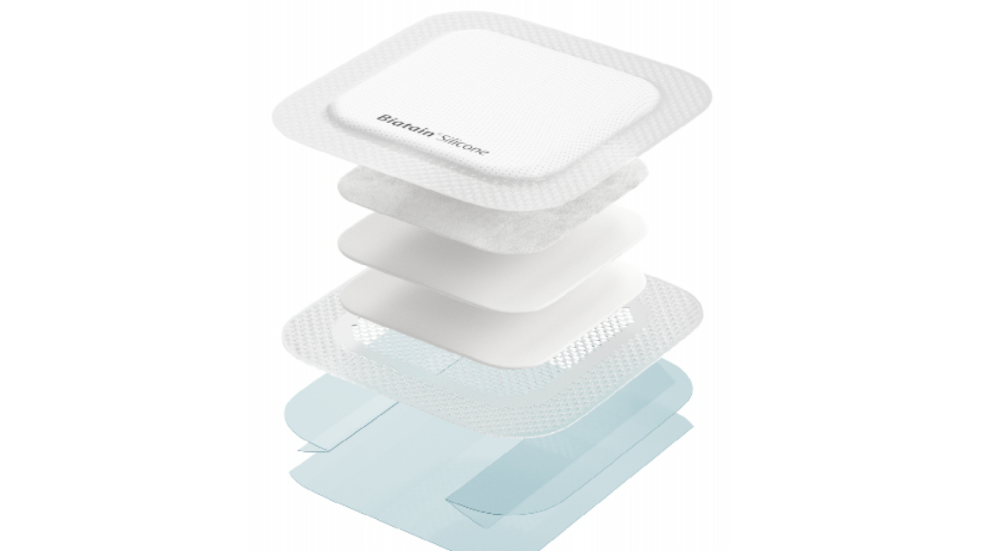
Biatain Silicone (Coloplast A/S, Denmark) is a conformable polyurethane foam dressing used for a wide range of exuding, acute and hard-to-heal wounds. It is multilayered, comprising a 3-piece non-touch application film, silicone adhesive layer, conformable foam layer, lock-away layer and semi-permeable top film [Figure 1]. The silicone adhesive layer is intended to provide a secure fit that keeps the dressing in place, with minimal pain and trauma on removal. At the central, absorbent part of the dressing, the silicone adhesive layer has a perforated structure.
The foam layer expands on contact with exudate, and with the perforated silicone adhesive layer, the expanding foam forms a three-dimensional structure that conforms closely to the wound bed, referred to as 3DFit Technology. The foam structure absorbs exudate vertically and, together with the lock-away layer, absorbs and retains fluid within its structure while keeping the wound bed moist. The lock-away layer contains superabsorbent particles embedded in a cellulose matrix to improve absorbency and retention of exudate within the dressing. Vertical absorption of exudate into the dressing, rather than across it, helps to keep exudate away from the periwound skin.
The semi-permeable top film is designed to be bacteria- and water-proof, protecting the wound while allowing water evaporation and gas exchange (Cartier et al, 2014; Chadwick et al, 2014). A thinner, more flexible version of the dressing is also available, called Biatain Silicone Lite (Chadwick et al, 2014). This does not contain a lock-away layer and therefore has lower absorbency and retention properties; it is suitable for a wide range of acute and hard-to-heal wounds that are non- to low-exuding. Both dressings can be used with compression therapy.
Fluid handling capacity
After initial uptake of exudate into the foam structure, evaporation of fluid through the backing layers enables additional moisture to be removed from the wound. If the backing layer is largely impermeable to evaporation, the absorbed exudate may saturate the foam, risking leakage (Gefen et al, 2024a).
Understanding fluid handling capacity is important, as failures in exudate management may lead to delayed healing (Gefen et al, 2024b). A higher fluid handling capacity also provides potential for longer wear times (Gefen et al, 2024a).
On behalf of Coloplast, an independent laboratory assessed the fluid handling capacity of 10 adhesive silicone foam dressings. Biatain Silicone displayed significantly higher total fluid handling capacity (28.93g/10cm²) than the other dressings tested [Figure 2; Nielsen, 2019). Similar results were found in a broader, independent evaluation of 20 adhesive silicone foam dressings by the National Health Service (NHS) in the UK, where Biatain Silicone again had the highest total fluid handling capacity (25.32g/10cm²) (NHS, 2018). Biatain Silicone Lite also displayed higher total fluid handling capacity than six other dressings in its category (NHS, 2018).
Exudate management
In an independent clinical evaluation of five adhesive silicone foam dressings conducted by a local skin integrity team at Doncaster and Bassetlaw Teaching Hospitals (UK), Biatain Silicone was ranked as having the best absorbency and fluid capacity. The evaluation and ranking were based on treatment of 50 wounds with each dressing (Vernon et al, 2023).
In a product evaluation by Cartier et al (2014), 830 HCPs assessed Biatain Silicone in a total of 958 patients. Of the wounds treated, 19% were low-exuding, 58% medium-exuding and 23% high-exuding. In 96% of cases, absorption capacity was rated ‘very good’ or ‘good’, and 74% of HCPs felt the absorption capacity of Biatain Silicone was ‘better’ or ‘much better’ than previously used foam dressings. Biatain Silicone received its best ratings for absorption capacity in the management of highly exuding wounds.
It has also been reported in two case series that Biatain Silicone and Biatain Silicone Lite effectively manage exudate (Chadwick et al, 2014; Wilson et al, 2019). The technical and clinical evidence indicates that Biatain Silicone has a high fluid handling capacity and effectively manages exudate, from low- to highly- exuding wounds.
Conformability
Exudate management also depends on the dressing’s ability to manage the gap between the wound bed and the dressing, where exudate can pool [Figure 3A]. Managing this gap has often involved the use of wound fillers (Wilson et al, 2019).
Many silicone foam dressings claim to be conformable; however, no standardised tests exist to quantify the level of conformability. Recently, a new in vitro methodology was developed to quantify conformability by measuring the height of foam products after swelling (‘bubble height’) within a fenced diameter [Figure 3B; Brennan et al, 2024]. Differences in the fenced diameter, representing different wound sizes, markedly affected the level of conformability; the study indicated that Biatain Silicone can conform to wound depths of up to 20mm where the wound has a diameter of 50mm (Brennan et al, 2024). To the authors’ knowledge, no studies have directly compared the conformability of different silicone foam dressing brands, and further research is needed to address this gap.
The conformability of Biatain Silicone appears well aligned with wound depths commonly encountered in clinical practice. In a retrospective cohort of more than 150,000 patients with over 300,000 wounds of various aetiologies, most wounds were less than 20mm deep, including 99% of diabetic foot ulcers (DFUs) and 99.9% of venous leg ulcers (VLUs) (Wilcox et al, 2013).
In a randomised controlled trial (RCT) by Voegeli et al (2024), 102 patients with hard-to-heal, non-infected VLUs or DFUs with a depth of less than 20mm were randomised to treatment with either Biatain Silicone or standard of care (a wound filler covered by a secondary foam dressing) for four weeks. After four weeks, conformability was rated ‘good’ or ‘very good’ for 90% of patients using Biatain Silicone, similar to the ratings for standard of care. The proportion of patients with periwound skin rated ‘nothing abnormal’ rose from 48% at baseline to 72% at follow-up in the Biatain Silicone group, but fell from 69% to 55% in the standard of care group. Biatain Silicone was as effective as a filler for managing the gap between wound bed and dressing in wounds with a depth of less than 20mm, and pointed to the potential for simplifying wound care by replacing a two-dressing regimen with a single-dressing regimen (Voegeli et al, 2024). Wound healing outcomes from this trial are discussed in a later section.
In a prospective, observational, real-world study in a community nursing setting, 64 patients with acute and hard-to-heal wounds of various aetiologies were treated with Biatain Silicone as the primary dressing and were followed until it was discontinued as the primary dressing (Colboc et al, 2024). Across 220 dressing changes for these 64 patients, nurses reported that the dressing conformed closely to the wound bed in 94% of cases. Exudate pooling in the wound bed decreased significantly over the study: 30% of patients reported no pooling at baseline, rising to 72% at final follow-up. The condition of the wound edges and periwound skin also improved significantly.
Overall, the 3DFit Technology of Biatain Silicone provides good conformability for most wounds with a depth of less than 20mm, with positive effects on exudate management, pooling, and the condition of wound edges and periwound skin [Figure 3C and 3D].
Dressing changes and pain
Dressings that adhere or stick to the wound can damage newly formed granulation tissue by stripping away fibroblasts, epithelial cells and extracellular matrix at removal, delaying wound healing. Adherent dressings have been associated with significant pain (Davis et al, 2015). The silicone adhesive in Biatain Silicone dressings is intended to enable atraumatic, painless removal.
Pain on dressing removal has been assessed for numerous adhesive silicone foam dressings in two independent evaluations (Vernon et al, 2023; NHS, 2018). In the NHS evaluation of 20 adhesive silicone foam dressings, Biatain Silicone ranked among the three best dressings for pain level at removal (NHS, 2018). This is supported by the Doncaster and Bassetlaw Teaching Hospitals skin integrity team evaluation, in which 92% of Biatain Silicone removals were considered pain-free (Vernon et al, 2023). In the real-world study by Colboc et al (2024) assessing 220 Biatain Silicone dressing removals, the average patient-reported pain was 7.6 on a scale of 0 (no pain) to 100 (severe pain). These findings are supported by product evaluations in which around 98% of HCPs rated Biatain Silicone easy or very easy to remove (Cartier et al, 2014; Wilson et al, 2019).
Wound healing
In the RCT by Voegeli et al (2024), the primary endpoint was percentage wound area reduction. Over four weeks, wound area reduction averaged 54% with Biatain Silicone compared with 43% with standard of care (P=0.299). Wound depth was reduced on average by 72% with Biatain Silicone compared with 61% with standard of care (P=0.165). Biatain Silicone was clinically comparable to a filler plus secondary foam dressing [Table 1]. Simplifying the wound care regimen also had important implications for the number of products used and cost of treatment (Voegeli et al, 2024), discussed further below.
Wound healing was also assessed in the real-world study by Colboc et al (2024), in which 64 patients received treatment with Biatain Silicone. Mean wound area was 9.7cm² at baseline, reducing by a mean of 6.1cm² by final follow-up. Between baseline and final follow-up, 48% of wounds had healed and a further 25% were progressing towards healing; 88% of nurses reported improved wound conditions at the final follow-up compared with baseline (Colboc et al, 2024).
Healthcare resource utilisation
The RCT by Voegeli et al (2024) showed that a simplified wound treatment regimen using Biatain Silicone was clinically comparable to standard of care (a filler and secondary foam dressing). During the four-week study, the mean number of products used was considerably lower with Biatain Silicone (5.6 products) than with standard of care (10.6 products). Based on UK unit costs, the estimated total product cost of treatment was £21.4 with standard of care versus £14.3 with Biatain Silicone, a lower cost of 33% (P=0.033; Table 2; Voegeli et al, 2024). This is consistent with a case series reporting product-related cost savings of 49% when using Biatain Silicone compared with a two-dressing regimen (filler and secondary dressing) in the community setting (Wilson et al, 2019).
The cost reductions reported in both studies relate only to savings in product consumption. The authors hypothesise that a simplified treatment regimen with Biatain Silicone may also reduce the time HCPs spend managing wounds, by reducing the need for fillers in the treatment pathway.
Based on the RCT results (Voegeli et al, 2024), a budget impact model was developed to estimate the financial implications of replacing a two-dressing regimen (filler and secondary foam dressing) with Biatain Silicone in the community setting in the UK. The target population comprised patients with VLUs or DFUs with a depth of ≤20mm and wound edges that were not undermined. The model incorporated the proportion of such wounds being treated with a filler and secondary dressing, and assumed gradual uptake of Biatain Silicone over five years.
Over this five-year period, the cumulative cost of products used for treating VLUs and DFUs in the community setting was estimated at approximately £33 million with the two-dressing regimen, versus approximately £28 million with Biatain Silicone, a saving of approximately £5 million on products alone. This model did not account for the implications on HCP time.
Bacterial sequestration
Exudate pooling in the wound bed may lead to infection if not managed properly (Bowler et al, 2001). Microbial colonisation can compromise the healing process and may become life-threatening if infection progresses to sepsis (Bowler, 2002; Sood et al, 2014). Antimicrobials are often used inappropriately in wounds that are not confirmed as infected, and are not always used appropriately in wounds that are infected (Hampton et al, 2023).
As an alternative mechanism for reducing bioburden, sequestering and thereby removing bacteria in the wound bed may reduce the need for antimicrobial intervention (Ousey et al, 2024). An in vitro experiment showed that Biatain Silicone can sequester Staphylococcus aureus cells and retain 99.98% of them even under external pressure (Braunwarth and Christiansen, 2019; Dowsett et al, 2020). Other polyurethane foam dressings have also been shown to sequester and retain bacterial cells, although significant differences between brands have been observed (Braunwarth and Christiansen, 2019; Ousey et al, 2024); the clinical implications of these differences warrant further study.
Discussion
Clinical evidence demonstrates that Biatain Silicone is an effective foam dressing for managing exuding wounds with a depth of less than 20mm. Its 3DFit Technology ensures conformability to the wound bed, reducing the risk of exudate pooling and leakage onto periwound skin (Colboc et al, 2024; Voegeli et al, 2024). Managing the gap between wound bed and dressing has traditionally relied on wound fillers (Wilson et al, 2019), but Biatain Silicone is clinically comparable, in terms of healing outcomes, to a wound filler plus a secondary foam dressing for wounds with a depth of less than 20mm (Voegeli et al, 2024).
While clinically comparable to a wound filler and secondary foam dressing, Biatain Silicone reduces the number of products needed for treatment and is therefore a cost-effective alternative (Voegeli et al, 2024).
A structured partnership between Coloplast and Norfolk Community Health and Care NHS Trust found that educational events on simplified wound care, and training on Biatain Silicone, reduced the use of wound fillers, delivered considerable cost savings and supported a more standardised treatment pathway (Sweeney, 2022). Biatain Silicone Lite has also been implemented in a simplified skin tear treatment pathway by the East of England Ambulance Service Trust (Hickey and Ayres, 2021), which aimed to provide more standardised, effective management of skin tears at lower cost. Initial, anecdotal feedback on this pathway was positive; however, the paper presented no quantifiable data to support substantial conclusions (Hickey and Ayres, 2021).
Future studies will investigate these outcomes as Biatain Silicone products are implemented more widely across an NHS Trust.