It is well recognised that foot protection to help redistribute pressure,remains the cornerstone for the prevention of pressure damage to the feet. Protection is integral to the national foot protection campaign ‘CPR for Feet’, where CPR stands for check, protect, refer. Protection means a medical device to help offload or distribute pressure.
The predicament for any clinician is the appropriate selection of a product from the many options that are currently available.
Any device must meet numerous criteria. The Tissue Viability Nursing Team in NHS Greater Glasgow and Clyde (NHSGGC) identified 10 criteria that, in their clinical opinion, a foot protection device should meet:
- Safe to use.
- Evidence based.
- Easy application for carers and nurses.
- Low margin for human error.
- Meet infection control standards
- Comfortable for patient to wear.
- Has moisture vapour wicking technology.
- Does not require additional products to be used to help make wearing the device tolerable for patients.
- Cost effective.
- Sustainability.
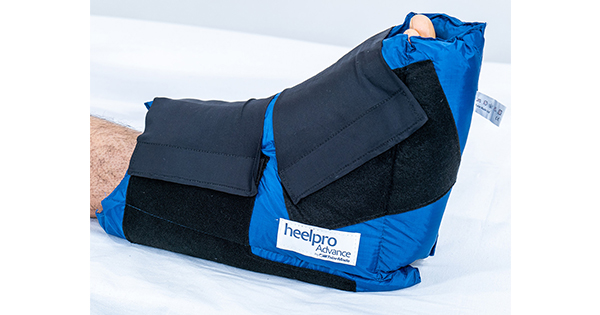
The tissue viability nurses (TVNs) therefore set out to find a product that would meet these criteria. After examining different products available on the market, they selected the HeelPro Advance Boot (TalarMade) to evaluate. It met all of the criteria, as described in the selection criteria match in Table 1.
100 patient evaluation
The manufacturer TalarMade was invited to participate in a 100 patient evaluation. The outcomes to be measured included:
- Reduction in pressure damage to feet.
- Patient feedback.
- Staff feedback.
- Reduction in referrals to orthotics.
- Cost savings.
A 92-bed district general hospital site, housing four inpatient wards (acute receiving, general medical and two elderly care rehabilitation wards) was selected for the following reasons:
- Representative of the wider patient population at risk of pressure damage to feet
- Control over the evaluation with minimising bias.
- Focused education prior to evaluation.
- Ease of collecting meaningful clinical and referral data.
After a period of staff education about the fitting and cleaning of the boot, the patient evaluation commenced on 1 December 2024. The evaluation lasted 10 weeks. During this time, the TalarMade clinical adviser made regular contact with the four participating wards to support with ongoing product education. The TVN obtained patient and staff feedback and the reviewed all healthcare-acquired pressure damage.
Results
Prior to the evaluation, up to four pressure ulcers per month were reported at the test site. Throughout the evaluation period and afterwards, only one patient developed pressure damage, and this was because she refused to have any form of foot protection in place.
Patient feedback was obtained by the TVN. Overall, the patients tolerated the HeelPro Advance well and were positive about them. They found them comfortable to wear. In one notable case, a patient with very painful gout reported that this was the first time he had experienced a comfortable night’s sleep in years.
Staff feedback was obtained through focus groups. The three main areas of positive feedback were ease of application, increased adherence by patients and comfort for patients.
Ease of application
Staff reported they were easy and quick to fit “without faff”. The universal size saved time in the selection and fitting process and gave staff the assurance that the correct size was fitted.
Adherence
Staff reported that patients do not feel that they have foot protection on and are less aware of them when in bed.
It was also reported that “patients are less distressed” and “even patients with delirium cope better with them”. One member of staff commented on the lack of noise from HeelPro Advance. She had identified noise as a trigger for cognitively impaired patients to remove boots.
Preference
Overwhelmingly, staff liked the HeelPro Advance.
One main area of feedback is that the feet are not “sweaty”, “fungally”, “smelly” and “clammy”. this is because of the built-in moisture vapour transmission rate, which other products do not have. They also noted that the boots “do not stick to skin” and “do not cause sweating’.
Orthotic referrals
During the evaluation period and afterwards, no referrals were required to be sent for specialist orthotic devices.
Cost-effective care
The NHSGGC pressure ulcer prevention policy advises that any foot protection fitted for a patient follows that patient on their journey, even if required on discharge. In effect, a single person use device meets this criteria. By making a direct switch from current foot protection on a boot-to-boot basis there can be £7,000 saving.
There are additional benefits, which include:
- Reduced harm from human error applying wrong size.
- Reduced harm from human error applying to wrong foot.
- Reduced harm from boots that can deflate.
- Reduced harm from moisture build-up in boots that do not wick fluid away.
- Reduced hidden cost of applying boot liner to manage the moisture
- Reduced time in the assessment for correct size and correct foot application.
Discussion
While we know pressure ulcer treatment is costly, the true cost is unknown. There is no readily available data that allows us to accurately estimate the true costs to our healthcare system either in an acute setting or in the community.
The pressure ulcer productivity calculator can be used for costings exercises (Department of Health and Social Care, 2010). A sample of 18 patients from the cohort, each with varying stages of pressure damage to the foot, was analysed. The total care cost for treating these individuals was £193,000.
This exercise highlights the ongoing financial burden of pressure ulcer management within healthcare settings. While tools such as this are useful in providing structured and detailed cost models, it is important to note that this calculator is based on cost data from 2008/09, and may not accurately reflect the current cost landscape, particularly when accounting for inflation, advances in treatment and evolving care protocols.
The study estimates a median cost of £7,800 per patient, with a range spanning from £1,382 to £10,065. These figures, while valuable for benchmarking, may underestimate the true cost in more severe or prolonged cases of pressure damage. However, it must be noted that these results include costing for nursing workforce time and bed occupancy time
Given the diversity in patient needs, stages of ulcer development, and treatment complexity, a more updated and comprehensive cost model may be required to inform future resource allocation and care planning strategies.
Recent research by Krupova et al (2025) on costs of pressure ulcers among inpatients at a Czech university hospital estimates a median of €929 (£800) per patient including pharmacotherapy (interquartile range €436–€1,947 or £370–£1,650). These costs may be an underestimate, given the price differences between countries.
Therefore, the investment in pressure-relieving equipment offsets the costs incurred if pressure damage occurs.
Conclusion
After testing the HeelPro Advance in 100 patients, the TVNs concluded that the device met their criteria for a foot protection device that was easy to apply, patients found comfortable, staff rated them highly and they prevented foot damage. The HeelPro Advance delivered cost-effective care without compromise on quality or comfort.